


26
Apr 2019
Apr 2019
Light Pollution Solutions

Photo by Benjamin Williamson
Q: What are “dark sky friendly” exterior fixtures?
A: Sounds like an oxymoron, right? Outdoor lamps are there to illuminate the darkness, helping us move around safely. But in so doing, many also allow light to escape into the night sky, a phenomenon known as light pollution that masks our view of the stars. In fact, an international group of scientists recently determined that the Milky Way is invisible to more than one-third of the world’s population, including nearly 80 percent of North Americans. Light pollution also contributes to energy waste, disrupts many ecological processes, particularly for nocturnal animals, and can have a negative impact on human health, interrupting sleep and causing headaches, stress, and anxiety.
In 2008, Bar Harbor — home to Acadia National Park, one of the most blissfully dark places on the eastern seaboard — passed an ordinance regulating outdoor lighting on all new construction in town. To comply, fixtures over 1,800 lumens must be “dark sky friendly” — i.e., have casings or canopies that shield the bulbs, preventing them from being seen from above. Other cities and towns, including Portland, have their own ordinance requirements for lighting; check with your municipality to find out what the rules are.
No matter where you live, I recommend choosing warm (no more than 3,000 Kelvin), dimmable LED downlights, like those described above, to curb light pollution, reduce glare, and create a soothing — versus blinding — outdoor environment. Remember also that you don’t need many fixtures to make an impact outside; learn about my less-is-more approach to landscape lighting here.
As for dark sky-compliant fixtures, these picks will adequately illuminate your home and yard and facilitate stargazing.


Cover Photo: On Acadia National Park’s Schoodic Peninsula, Down East’s director of photography, Benjamin Williamson, captured the Milky Way and bioluminescence in the water.
19
Apr 2019
Apr 2019
Lessons from the Louvre
Q: What’s the best way to illuminate artwork in my home?
A: If you’ve invested in a beautiful piece of art, you want to display it in the best possible light. One way of doing this is by directing ceiling-mounted spotlights or track fixtures at works exhibited on walls or shelves. This approach works well in a minimalist space and offers flexibility if you like to move things around. Picture or track lights installed on the wall or the frame of an individual work are another option that creates intimacy in a room by visually lowering the ceiling and drawing viewers in for a closer look. Here are examples from our store of Tech Lighting’s Georgi lamp mounted on track and “monopoint” canopies:


Until recently, halogen bulbs were the lamps of choice for accenting artwork, but today’s LED equivalents have evolved to provide a strong alternative. The European Union has been phasing out the use of halogen spotlights since 2016 and will issue a wider ban of halogen bulbs in 2018. Accordingly, museums have been shifting to LEDs, which offer significant energy savings, lower costs, and better light distribution. Equally important: unlike halogens and other incandescent bulbs, LEDs do not emit the infrared and ultraviolet rays, and accompanying heat, that can damage artwork.
Did you know that Leonardo da Vinci’s Mona Lisa is illuminated with LED lamps in the Louvre? Specifically, the masterpiece is lit with a custom Toshiba fixture comprised of 34 LED bulbs with precise spectrum controls. Works in the museum’s famed Red Rooms are also enlivened with Toshiba LEDs.
While we can’t provide our clients with highly specialized lamps like the Louvre uses, we have discovered an excellent system for customizing any LED fixture. The SORAA Snap System, used with the lamps above, consists of magnetic disks that snap onto the face of a bulb, allowing you to change the size, shape, and color of the beam to suit your artwork.
We love to support the local art community and regularly invite artists to exhibit and sell their work in our showroom. As you may have guessed, we are currently showing images by nature photographer John Orcutt. Stop by for a tour and demonstration on how lighting can transform your artwork. Here’s a sampling of some of the diverse products you’ll find:


12
Apr 2019
Apr 2019
Tips (and Task Lights) for Aging Eyes
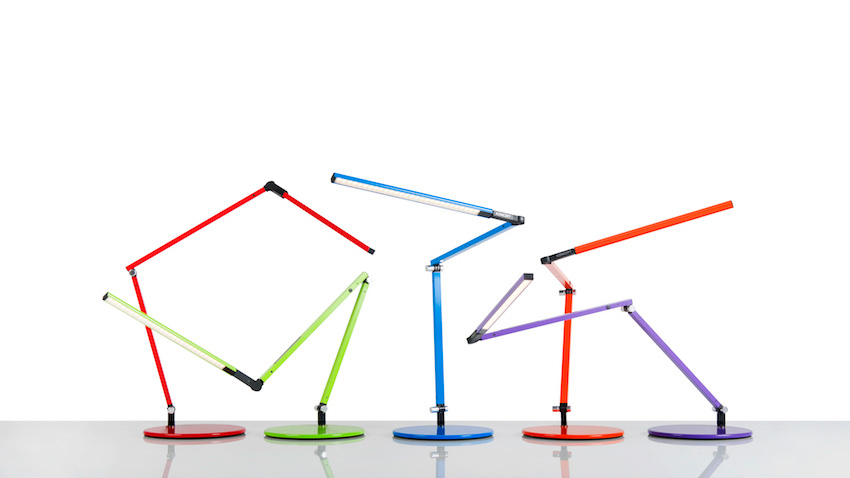
Q: As I get older, I’m finding it harder to see when I read or do other simple tasks in my home, even with my glasses on. Can you suggest some lighting improvements that might help?
A: When I was a teenager, I used to kid my father because he could not read menus in dimly lit restaurants. Now that I’m in my 70s, I realize how insensitive that was! As we age, our pupils actually get smaller, so less light makes it to the back of the eye. Many people start noticing changes in their vision around age 50 and, by the time you’re my age, you need about three times as much light as a 25-year-old does to read and perform fine-motor tasks. In addition to more wattage, older adults need glare-free illumination that is consistent from room to room, since moving from a low-light space to a bright one can be disorienting.
At Fogg Lighting, one of the things we try to educate people about is the concept of layers of light. Basically, you need a mix of light sources at different levels to create a properly lit space. We generally establish a first layer of ambient illumination in a room using decorative fixtures such as a chandelier, pendants, or semi-flush or flush-mount units. Accent and task lighting — typically some combination of well-placed recessed or track fixtures, sconces, under-cabinet units, cove lights, and table and floor lamps — fills in the shadows and helps you see what you’re doing. Contrast this scenario with one in which recessed fixtures are the only light source, as is sometimes the case in hallways. Used on their own, these units create pockets of light and darkness that make the area difficult for seniors (and toddlers!) to navigate.
For reading and other activities, it’s important to have a dedicated fixture that can accommodate the equivalent of a 100-watt incandescent bulb. Choose an opaque shade to reduce glare and an articulated arm if you want the option of shining the light onto a book. Here are a few of my favorite products.


These dimmable lamps by Holtkotter have transitional shapes and efficient halogen bulbs. Adjust the height of the floor lamp and move the arm to direct light where you need it.


For a more modern look, I love these sleek LED fixtures by Koncept, which are dimmable, adjustable, and work well in tight spaces.
Want more information? We are trained to design lighting plans that will see you through the aging progress. Stop by our store for a free consultation tailored to your specific needs.
5
Apr 2019
Apr 2019
Understanding LED Light Bulbs
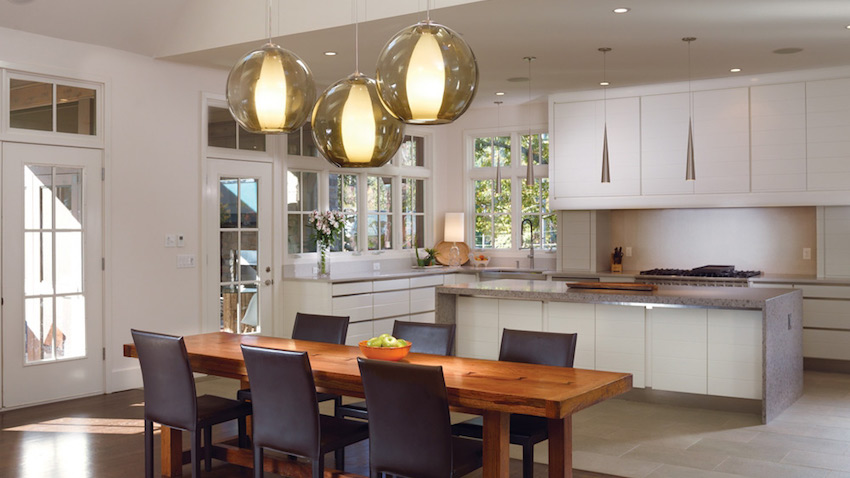
Q: It used to be easy to replace a light bulb; now there are so many options, I don’t know what to choose. What do you recommend?
A: It’s hard to imagine a household commodity that has changed more in the last five years than the light bulb. The incandescent bulbs we all grew up with wasted a lot of energy and have been phased out. Government mandates ushered in the brief reign of the more efficient, but widely despised, compact fluorescent bulbs, or CFLs, which emit terrible-quality light and are difficult to dispose of because of their mercury content. The public’s loathing of CFLs accelerated the development of light-emitting-diode bulbs known as LEDs, which now rule the lighting world. These use up to 80 percent less energy than the old incandescents and can last for decades. LEDs are improving all the time and their prices are coming down. However, the quality of light they produce varies significantly, so it’s helpful to understand some lighting nomenclature before you buy.
Most LED bulb boxes have a Lighting Facts label that indicates brightness (measured in lumens), color temperature (labeled K for Kelvin temperature), energy use, estimated energy costs, and expected life. Since most packages also specify the type of incandescent bulb the LED replaces, you don’t need to pay much attention to the brightness measure. Instead, zero in on color temperature: 3,000K is my recommendation for a universally flattering, warm-white light. Anything higher is going to have a cooler, bluish-white cast. Another good measure is the Color Rendering Index, or CRI, which tells you how accurately the bulb renders colors compared to an incandescent bulb, which has a CRI of 100. For LEDs, a CRI of 80 or higher is best.
To ensure an LED will fit in your fixture, bring your old bulb with you to the store and compare the bases. The splayed fins that LEDs have to dissipate heat make them larger than other bulbs. Make sure the bulb is dimmable (you may need to replace your dimmer switches with LED-friendly ones to avoid annoying flickering or buzzing). And if you plan to use the bulb outdoors and/or in an enclosed fixture (some LEDs require more airflow than these lights provide), check that these applications are noted on the box.
If you haven’t already, now’s the time to embrace this new technology — unlike previous innovations, this one is here to stay.
29
Mar 2019
Mar 2019
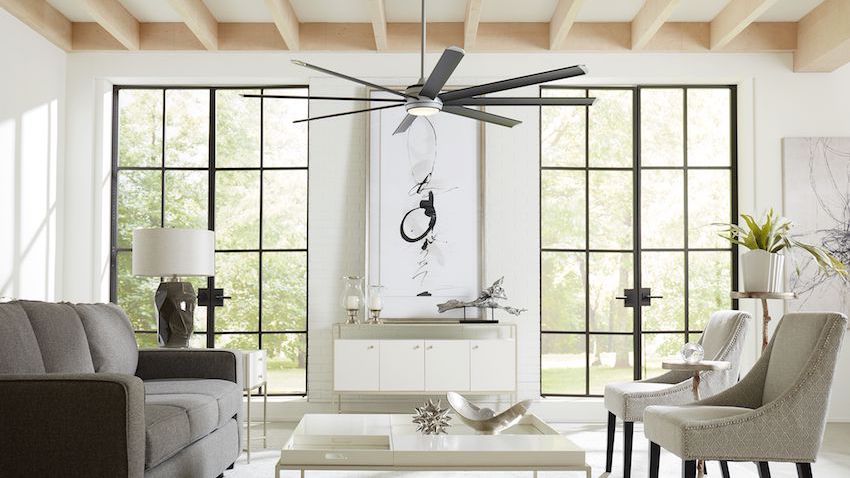
Q: How effective are ceiling fans and what should I look for when shopping for one?
A: Ceiling fans have a place in every home. While they do not lower the temperature, they make you feel more comfortable on steamy days by evaporating moisture on the skin and reducing body heat. In the winter, you can reverse the motor so the blades rotate clockwise and run the fan on low to gently recirculate the warm air that normally gets trapped near the ceiling. By employing ceiling fans throughout the year, and therefore relying less on your furnace and AC, you can save up to 20 percent on heating and cooling costs.
Aesthetically, ceiling fans have gotten a bad rap over the years, but they’ve come a long way. There are now many attractive ones available in a wide range of designs — from traditional shapes with streamlined styling to futuristic models with curvy, aerodynamic blades. A lot of fans are also equipped with LED lights that provide good ambient illumination. Check out some of my favorite styles, below.
Once you’ve zeroed in on a fan style, be sure to pick one with a blade span that is right for your room. A 36-inch unit is appropriate for small rooms up to 75 square feet; for spaces up to 144 square feet, choose a 42- to 50-inch one. Large rooms up to 255 square feet require a 52- to 54-inch model and those up to 400 square feet need a 54- to 72-inch one. Use multiple fans in a room that’s bigger than 400 square feet. Look for blades with a 14- to 16-degree pitch for optimum air movement, measured in cubic feet per minute (cfm). I recommend a fan with a cfm rating of 5,000 or higher, which will have a stronger motor, last longer, and operate more quietly than other types.
For best performance, mount your fan seven to 10 feet from the floor and six to eight inches from the ceiling. Every three months or so, wipe down the blades with a dampened cloth to remove dust that can curb efficiency and cause wobbling.


22
Mar 2019
Mar 2019
Planning Landscape Lighting

Q: What’s a good strategy for lighting a yard?
A: I suggest following a less is more approach. You don’t want your yard to be lit up like a theme park, and I promise your neighbors don’t either. Too much exterior light can be blinding, uses unnecessary electricity, and contributes to the brightening of the night sky, making it difficult to see stars and disrupting animal habitats. Instead, focus on installing fixtures where you need them — near a patio or path, for example — and accentuating a few special features in the landscape. In addition to making your yard feel inviting when you’re outdoors, these pockets of illumination give you something to gaze out at (other than a black window) when you’re inside your home at night.
I recommend down lighting, also known as moonlighting, as an environmentally friendly means of landscape lighting. You can place downlights, which have a cylindrical casing around the bulb to eliminate glare, high up on tree trunks and aim them at a walkway, seating area, or the tree’s own foliage for a moonlit effect. Path lights — typically 18- to 24-inch posts topped with canopies that direct light downward — are a good choice for highlighting plantings in a garden. Modern versions, such as those shown above, are also available. Place path fixtures about 20 feet apart to create glowing areas that draw the eye from one plant to the next versus a single blast of illumination. Avoid stationing these lights at regular intervals along a path, which conjures a landing strip, and using them on lawns, where they are vulnerable to lawnmowers and weed wackers.
Opt for solid brass or copper fixtures, which hold up well in Maine weather and can withstand the occasional ding from a power tool, and use 20-watt equivalent LED bulbs. These last up to 20 years in a landscape setting (compared with six months to a year for halogen bulbs), a lifespan you’ll be especially thankful for if your fixtures are in a tree.
17
Mar 2019
Mar 2019
Positioning Bathroom Fixtures
By Sanford Fogg
Photo Courtesy of Tech Lighting
Q: What’s the proper way to light a bathroom?
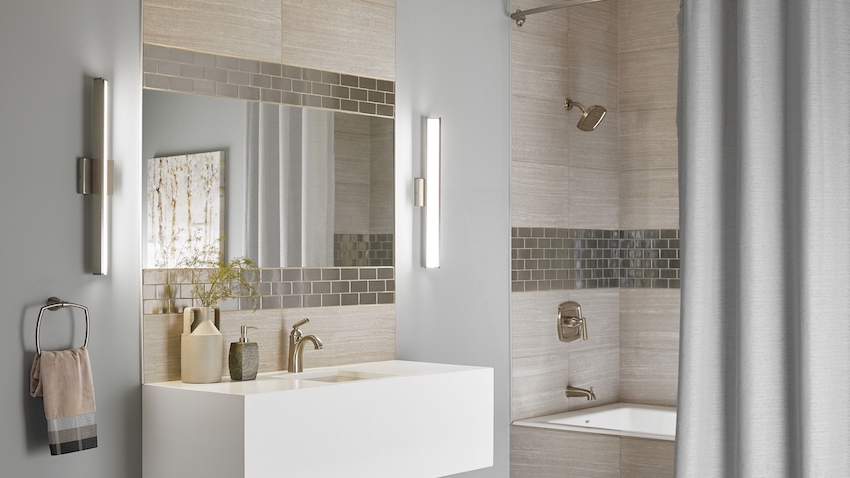
A: While the most critical need is adequate lighting at the vanity, I recommend incorporating additional layers of ambient and task lighting in a large space. In a master bathroom, these might consist of a centrally located ceiling fixture, a recessed light over the toilet, and recessed light(s) in the shower. In a powder room, vanity lighting alone might be sufficient (although I always recommend a recessed fixture over a toilet). Every situation and budget is different. But if you spend $10,000 to tile your walk-in shower, you should allocate $200 more to light it properly! For those on a smaller budget (i.e., most people), installing an exhaust fan with a light over the tub/shower is also a fine solution.
Sconces mounted beside the mirror at approximately head height, 65 to 70 inches above the floor, provide the best vanity lighting. These produce even illumination across the face. A sconce or bath bar installed above the mirror provides the next-best lighting. Most lighting designers advise against having recessed fixtures over a vanity as they create shadows under the eyes, nose, and chin, making tasks like shaving and applying makeup more difficult.
Opt for sconces with opal versus clear-glass shades, as the latter tends to produce glare. When choosing fixtures, I recommend ones that accept a minimum of 60-watt light bulbs, or the equivalent in an LED, per sconce. Like all lights, these fixtures should be on a dimmer that you can crank up when you’re getting ready in the morning, and down when you want to relax in the bath.
15
Mar 2019
Mar 2019
Choosing Exterior Fixtures
By Sanford Fogg
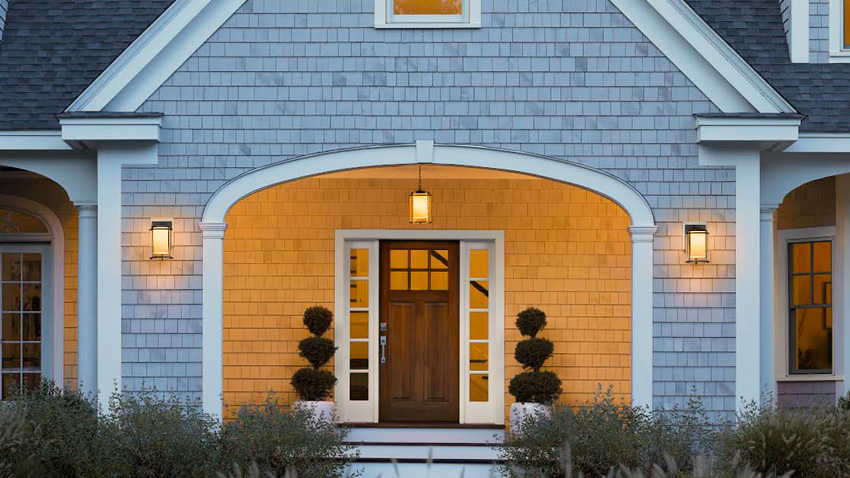
Photo Courtesy of Hubbardton Forge
Q: What should I consider when selecting fixtures for the exterior of my house?
A: The first step is determining the type of fixture, or fixtures, that best suit your house. This is, of course, a matter of personal taste. A flush-mount fixture works well on porches with low ceilings, while a pendant can be a good match for higher ceilings, depending on wind. Sconces on one or both sides of the door are a classic choice and can be combined with a ceiling fixture if you have a portico. If you have a tight space with no covering overhead, mount a single sconce near the door on the handle side. Whatever style you choose, invest in a quality material, such as copper, brass, or powder-coated forged steel. These metals come in multiple finishes and hold up well in Maine weather.
Choosing exterior fixtures that are too small is a common mistake people make. Lanterns that look large in a crowded showroom often get lost on the broad façade of a house. And when you stand back 50 feet, they appear about half their size. As a general rule, select models that are roughly ¼ to ⅓ the overall height of the door. Before making a purchase, cut cardboard to the size and shape of the light and affix it to your house, then stand on the street and see how it looks. Lamppost fixtures should match those in the entry and be approximately the same size. Garage fixtures are usually a little smaller and can be a different style if they are not visible from the front of the house.
Glare is another issue with a lot of exterior lights. A prime example is the motion-sensor flood lighting many people have on their garages. Instead of helping you see, these fixtures actually blind you! When it’s dark out, a little light goes a long way. One frosted, 40-watt-equivalent LED bulb per fixture is usually just right. To truly minimize glare, and light pollution in your community, opt for a “dark sky” fixture, which has a shade that shields the bulb and directs the beam downward — your neighbors will thank you!
7
Mar 2019
Mar 2019
Illuminating a New Home or Remodel
By Sanford Fogg
In a new monthly column, Sanford Fogg, of Fogg Lighting in Portland, offers his best advice on illuminating your home.
Q: What’s the most important thing to consider when planning lighting for a new home or remodel?
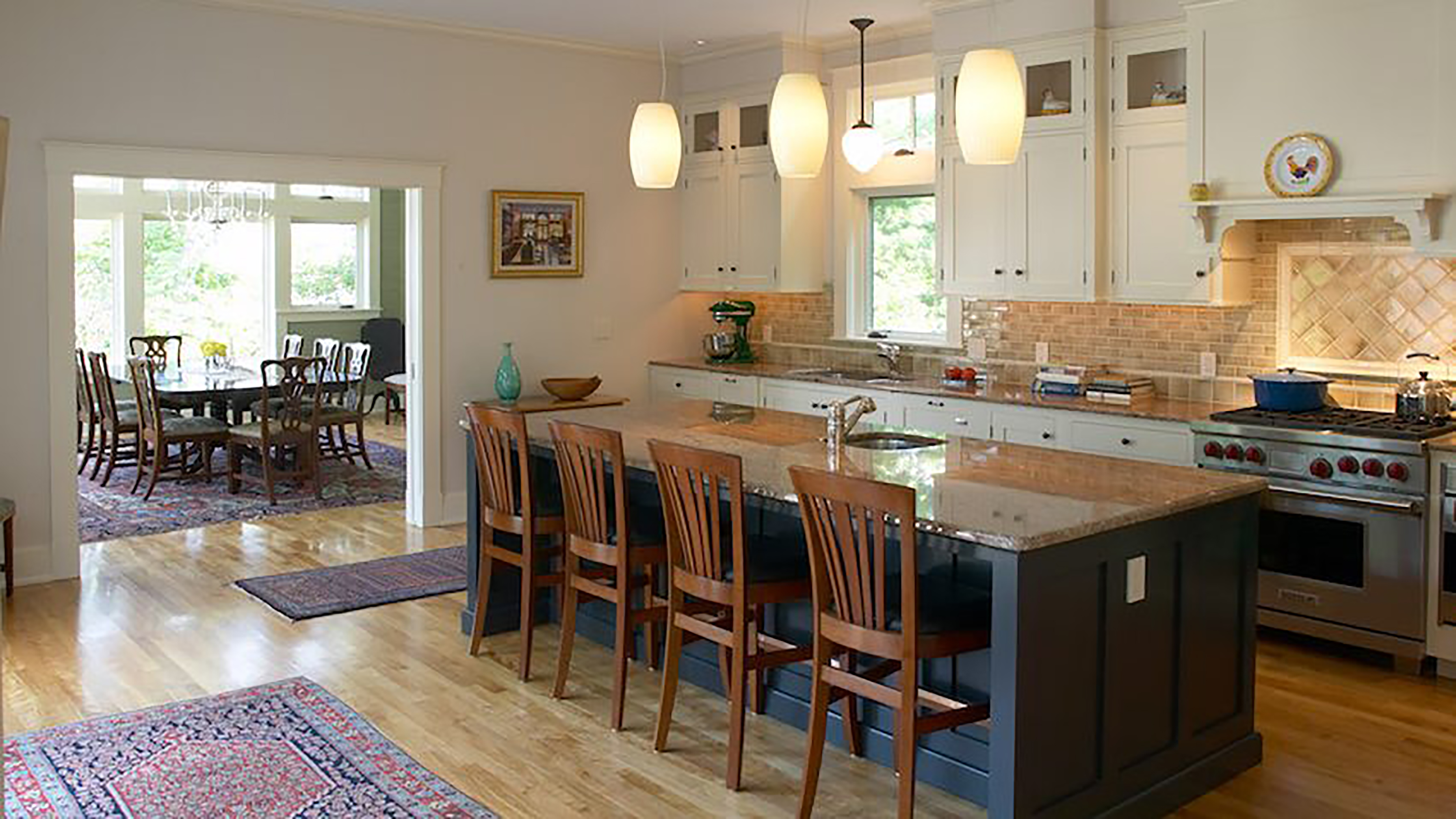
A: Bringing in a lighting designer at the start of a project is key. This is not a luxury reserved for people with big budgets. We will consult with any customer, free of charge, in our store. For a reasonable charge, we’ll also make a house call, but this is not typically necessary. Working with floor plans or drawings, we can determine how much light you need in a room, what types of fixtures will work best, and where they should go. Because lighting is one of the last things to be installed in a house, people often don’t contact us until the final weeks of a project. At this point, the wiring is done and it’s no longer possible to alter the lighting plan. We see kitchens that are drastically under-lit, with a grid of recessed lights in the center of the room instead of over the work surfaces. In living rooms, people frequently use recessed fixtures like klieg lights overhead, when they should be positioned around the room’s perimeter to create more comfortable, ambient illumination — to name just a couple of potential pitfalls.
Because contractors’ allowances are sometimes not enough to cover the type of lighting homeowners want or need, we also help clients devise a realistic budget up front so they are not hit with unexpected costs at the end of the process. You can spend a lot of time and money on your plans and architect, and choose the prettiest countertops, tile, and art, but if you don’t light it all properly, you can’t take full advantage of, or truly appreciate, the work you’ve done.
24
Mar 2018
Mar 2018
The World Is Getting Brighter

A Re-print From US News and World Report
BY WILL DUNHAM
WASHINGTON (Reuters) – The world is getting brighter, but scientists say that may not be a good thing.
Researchers said on Wednesday satellite data showed that Earth’s artificially lit outdoor surface at night grew by about 2 percent annually in brightness and area from 2012 to 2016, underscoring concerns about the ecological effects of light pollution on people and animals. (more…)