


Aug 2013
A Ceiling Fan For Every Room!

Ceiling Fans are Cool! Ceiling Fans are Hot! Right on both counts. Ceiling fans help you feel cool during the warm months and help warm a house during the cool months. By so doing they can save up to 20% of the cost of both heating and cooling. They do not actually cool the house, but they make you feel cool because they move air over your skin which increases the evaporation of the moisture on your skin. And they do not actually heat your house, but they recirculate the warm air that otherwise would be trapped near the ceiling. So in the summer you can turn your thermostat to a higher setting and in the winter the warm air being recirculated keeps the lower part of the room warmer lessening the call for the furnace to come on.
 |
| Cool Fan! |
Ceiling fans come with different size blades so you will want to select the correct size fan for the size of your room. A 36″ fan is appropriate for small rooms up to 75 square feet. A 42″-50″ fan works well in rooms between 76-144 square feet. Rooms that are 144-255 square feet are right for 52″-54″ fans. A large room that is 225-400 square feet should use a 54″-72″ diameter fan and it is appropriate to use multiple fans in a great room that is larger than 400 square feet.
Ceiling fans are available with lights or “light kits” so they can be used to add light to a room. Contrary to popular opinion, the lights do not have to be ugly, even though a lot of them are really, really ugly. Those ugly fan lights have given all fan lights a bad reputation. Some ceiling fans have full function remote controls thereby enabling you to reverse the direction of the fan, change the speed of the fan and turn the lights on or off from the comfort of your Lazy Boy. Some fans have a reversing switch on the body of the fan and others cannot be reversed at all.
There are many, many ceiling fans available today in all kinds of styles, sizes and colors. Be sure to choose a good quality fan with a strong motor and blades that are at least a 14 pitch. Please visit us at https://www.fogglighting.com and like us on Face Book.
Aug 2013
I’m Not Building a Big House, Why Do I Need a Lighting Plan?
A “Not Very Big House” today costs $300,000, $400,000 or more to build. A simple lighting plan costs a couple hundred dollars, an infinitesimally small percentage of the cost of a house. Yet a lighting plan can help you avoid making mistakes that are very expensive, if not impossible, to correct. A good lighting plan will add many times more value to your home than you could imagine by placing the proper fixture in the proper place, by high-lighting features that should be high-lighted and by using layers of light to add interest and depth.
 |
| Simple Lighting Plan |
As I have said in a previous posting, the house you are building or remodeling is going to be your home. You will be living there. You will be entertaining there and you will be cooking, reading, sewing, sleeping and grooming there. Not your contractor nor your electrician nor your architect (or draftsman). They all know what they usually do for lighting, but what they usually do might not be correct, even your architect might not get it right. If you can not afford a lighting designer read as much as you can about proper lighting design (this blog for example) and do your own lighting plan. Hand draw it on a copy of your blueprint.
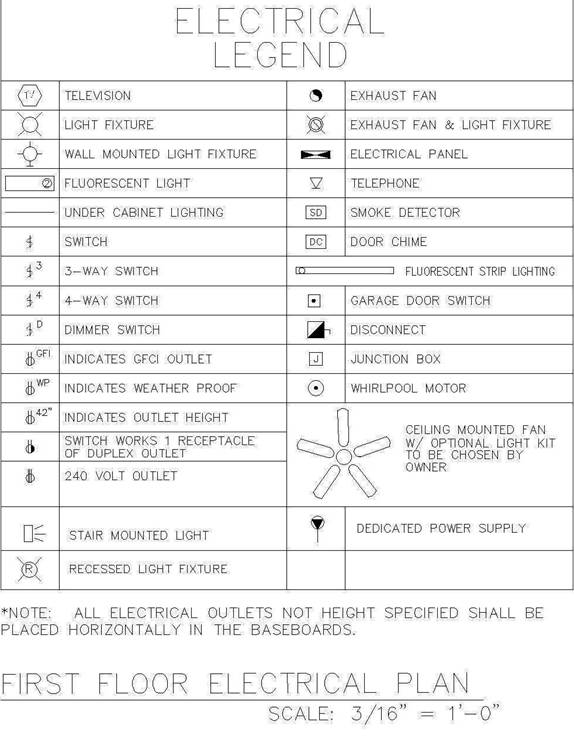 |
| Lighting Schedule |
Be sure to include a schedule of symbols so that everybody understands what the symbols on the plan refer to. It does not need to be formal but it needs to be specific. The symbols on the schedule to the right are commonly used on plans so most electricians are familiar with them.
How the fixtures are switched is also an important consideration. Think about where you will enter and exit a room and what you do while you are in the room. For example, you probably want a switch by the door when you enter your bedroom, but you might also want a switch by the bed so you do not have to get out of bed to turn the light off. I strongly recommend dimmers for every light in the house. They cost a little more than switches, but they add so much versatility that they are really worth the extra.
Most of all — BE AWARE THAT THE BUDGET YOUR CONTRACTOR GIVES YOU FOR LIGHTING IS NEVER ADEQUATE — NEVER. They are trying to quote you the lowest possible price for your project to get the job, and they always scrimp on the lighting budget, as well as tile, plumbing fixtures, etc.
Please visit us at www.fogglighting.com, read my blog posts to educate yourself about lighting, like us on Face Book and tell your friends about us. More to come in following days.
Aug 2013
Decorative Lighting Guidelines for any Room – Semi-Flush Mounts

Decorative lighting includes Wall Sconces, Chandeliers, Flush Mounts, Semi-Flush Mounts and Pendants. The proper combinations of these five elements insure an interesting, attractive lighting design for any room. Using different elements of lighting is called layering. Many layers of light make the difference between an OK room and WOW room.
 |
| Classic Semi-Flush Mount |
So what is a semi-flush mount? A semi-flush mount is shorter than a pendant and longer than a flush mount. It is the fixture of choice when you have sort of high ceilings and would otherwise use a flush mount, or conversely when you have do not have high enough ceilings to accommodate a pendant.
Without the steep vertical space requirements of pendants and chandeliers, semi-flush mounts can provide the same beautiful styling in a more compact form. Hallways, single story foyers, bedroom ceilings and bathroom ceilings are excellent spots for semi-flush mounts. They are perceived as more elegant that flush mounts and are used in a multitude of applications. Semi-flush mounts should be mounted so that there is at least 7′ of space between the floor and the bottom of the fixture. As with flush mounts they should be spaced 10′ apart if being used in a hallway.
Semi-flush mounts are available in a multitude of different styles, combinations of glass and metal, finishes and colors. Semi-flush mounts have a place in almost every lighting plan. Take a semi-flush mount home today!
Please visit https://www.fogglighting.com and like us on Facebook. I am always available for consultations on lighting plans.
Jul 2013
Decorative Lighting Guidelines for any Room – Pendants

Decorative lighting includes Wall Sconces, Chandeliers, Flush Mounts, Semi-Flush Mounts and Pendants. The proper combinations of these five elements insure an interesting, attractive lighting design for any room. Using different elements of lighting is called layering. Many layers of light make the difference between an OK room and WOW room.
 |
| How’s This For a Cool Pendant! |
Pendants are perhaps the most versatile of all decorative lighting fixtures.They can be as dramatic as a chandelier, as understated as a wall sconce or as functional as a floor lamp. They can be used to provide ambient, task or accent illumination. They can be used alone on in groupings. They are available as line voltage, low voltage halogen and LED. They can be made of glass or metal or a combination. They can be modern, traditional or transitional. Whatever your taste and lighting need there is a pendant for you.
Pendants are traditionally used in kitchens as task or accent lighting over islands, sinks or kitchen tables. But pendants are also used in foyers, in hallways with high ceilings, in dinning rooms over tables and in bathrooms. They are used as exterior fixtures on porches and entries. As long as you have adequate ceiling height, you can use pendants almost anywhere.
When choosing a pendant be sure that the light output meets your lighting needs. I have customers who would love to have small, colorful pendants over task ares in their kitchens. Unfortunately most of these do not provide enough task light for the application. So unless you can supplement the light with recessed lighting, such fixtures do not provide sufficient lighting for kitchen tasks. Be a savvy shopper and always match your lighting needs to the fixture you are buying.
Please visit https://www.fogglighting.com and like us on Facebook. I am always available for consultations on lighting plans.
Jul 2013
Decorative Lighting Guidelines for any Room – Flush Mounts

Decorative lighting includes Wall Sconces, Chandeliers, Flush Mounts, Semi-Flush Mounts and Pendants. The proper combinations of these five elements insure an interesting, attractive lighting design for any room. Using different elements of lighting is called layering. Many layers of light make the difference between an OK room and WOW room.
 |
| Hip Flush-Mount |
Flush mounted light fixtures are the most maligned light fixtures of all fixtures. They have earned their reputation because of all the bad flush-mounts out there in the lighting universe. Guess what – there are some really attractive flush-mounts available and they are absolutely needed in lots of applications. In certain applications, when you do not want to make a decorating statement, there are really plain vanilla flush-mounts that just sort of disappear on a white ceiling. Flush-mount do not have to be ugly! Dispense with any preconceived notions about flush mounted fixtures and welcome them into your home. You do not have to be ashamed to say you have a flush-mount in your front hall!
Because they illuminate with little downward obtrusion, flush mounted fixtures are ideal for providing ambient light in high traffic areas, such as hallways. They can also work well as a centerpiece when a lower hanging fixture would interfere with views or flow, especially when ceiling height is limited. I like using a flush mounted center ceiling fixture in bedrooms, usually a plain white one. Closets and laundry rooms are other areas where a flush-mounts are ideal. Outside porches, bathrooms and even showers are opportunities for using flush mounted fixtures, provided they have either damp or wet location ratings. Let your imagination be your guide.
Please visit https://www.fogglighting.com and like us on Facebook. I am always available for consultations on lighting plans.
Jul 2013
Decorative Lighting Guidelines for any Room – Chandeliers

Decorative lighting includes Wall Sconces, Chandeliers, Flush Mounts, Semi-Flush Mounts and Pendants. The proper combinations of these five elements insure an interesting, attractive lighting design for any room. Using different elements of lighting is called layering. Many layers of light make the difference between an OK room and WOW room.
 |
| Beautiful New Design |
Chandeliers, the crown-jewel of a room’s lighting array, is a showpiece of decorative sentiment and material beauty. Chandeliers are available in a multitude of different styles and designs, from the sublime to the ridiculous and everything in between. Your choice of a chandelier is a very personal matter. Some folks like a lot of metal, some like crystal, some like modern and some like traditional. There is no wrong choice. It is purely a matter of personal taste. Since the chandelier is usually the focal point in a room it sets the design fulcrum of the room.
Proper sizing is essential in choosing your lighting centerpiece. Too small and your chandelier will be lost among the other elements in the room. Too large and it will obtrude. There are a few guidelines for picking the correct size chandelier. Add the dimensions of the room in feet and then use that result in inches to determine the diameter. For example: a room is 10′ x 12′, add 10 + 12 = 22′ converted to inches = 22″, a 22″ diameter chandelier would be appropriate. The larger the room the more variance is allowed. A chandelier over a dining table should be no larger than 3/4 the table’s width and extend no closer than 6″ to the table’s edge. (A chandelier over a table should be at least 30″ above the surface of the table. The higher the ceiling, the higher above the table it can hang up to 36″). The height of a chandelier is determined by the ceiling height. Obviously a really high ceiling can accommodate a taller chandelier than a really low ceiling.
Please visit https://www.fogglighting.com and like us on Facebook. I am always available for consultations on lighting plans.
Jul 2013
Decorative Lighting Guidelines for any Room – Wall Sconces

Decorative lighting includes Wall Sconces, Chandeliers, Flush Mounts, Semi-Flush Mounts and Pendants. The proper combinations of these five elements insure an interesting, attractive lighting design for any room. Using different elements of lighting is called layering. Many layers of light make the difference between an OK room and WOW room.
 |
| Decorative Wall Sconce |
Wall Sconces placed midway on the wall can be used to balance overhead lighting and add a thoughtful dimension to your decor. The eye-level spread of light along a wall helps create an intimate ambiance in rooms and halls. As accent pieces, sconces can be used to flank architectural features, such as fireplaces and archways. In bedrooms sconces can be mounted on each side of the bed to serve as reading lights. While it is not necessary to match sconces to the style of overhead fixtures, keeping them within the same finish family will add continuity to the overall design. I actually like to combine modern and traditional styles in the same room to add a little pizzazz.
A sconce’s light source, not necessarily the back plate, should be mounted between 65″ – 68″ above the floor. Some sconces are linear and the back plate is either higher or lower than the actual light source. In these cases the electrical junction box must be located in the proper position on the wall to enable the light source to be at the proper height. Some scones have a narrow back plate and require a narrow junction box, called a switch box, rather than the junction boxes that most electricians routinely install. Please be sure to keep these facts in mind to avoid disappointment during the installation phase of your project.
Please visit https://www.fogglighting.com and like us on Facebook. I am always available for consultations on lighting plans.
Jun 2013
Factors to Consider in a Lighting Plan – Part 1
There are many factors to consider when designing lighting for an architectural space. One of the most important factors is ease of seeing. Ease of seeing varies greatly, but generally speaking older people need more light to see the same details than younger people can see with less light. Eyes over 40 years old are older eyes for this this discussion. People who wear eyeglasses are also susceptible to having issues as well. Age effects vision in a number of ways including depth perception, peripheral vision, glare, and visual acuity.

The photo at the left shows a room that has a lot of daylight as well as artificial light from many sources. It is a comfortable, inviting space with a relaxing color pallet. The lighting in this large room is one of the most important factors in how the room feels and how easy it is to navigate through the space. Furthermore there is adequate light for the tasks that are performed there. This room is comfortable for both young and old eyes. There is no glare, there is plenty of light and the walls are well defined. The lighting designer provided many layers of light without overpowering the space. A great balance.
Please be sure to visit FoggLighting.com and contact us with your questions and to help with your lighting needs. Our staff is trained in lighting design and can help with all your lighting questions.
Jun 2013
The Psychology of Lighting Design

It is crucial for a lighting designer to know how humans react to different colors of light and to the contrast between light and dark. This knowledge combined with knowing what tasks are performed enable the designer to effectively illuminate an interior space.
The eye functions almost like a camera sending images to the brain. Cones in the eye provide color vision in bright environments and rods in the eye provide shades of gray in dark environments. Brightness defines luminance which is the intensity of light entering the eye. Light meters measure this as lumens. The variations in the brightness of objects is defined as contrast. Colors in the middle of the visible spectrum appear brighter than colors at outside edges of the spectrum.
People react differently to different colors and have likes and dislikes for colors. Light and color influence our mood and feeling and affect our biorhythm and circadian rhythm. Red light is psychologically stimulating and can even raise blood pressure and heart rates. Red objects appear closer that they actually are. Blue is the opposite of red. It has a calming effect and appears further away that it is. Green is the most restful color for human vision.
In addition to color the amount of contrast determines how one perceives an architectural space. Environments that are complex, asymmetrical, unfamiliar or unorganized cause a sensory overload. In such situations complex tasks are avoided because people are distracted, annoyed or frustrated. Therefore attention to color, contrast and the activities that occur will enable a lighting designer to match the lighting to the tasks and create an inviting space.
Be sure to visit FoggLighting.com and like us on FaceBook. We have trained personnel to help you with lighting design and fixture selection.
May 2013
Home Theater Lighting
In today’s upscale homes an home theater is becoming more and more common all the time. Why go out when you can have all the benefits of the big screen in the comfort of your home! Of course lighting a home theater must be executed correctly to fully enjoy the viewing experience.
 |
|||
| Front view of a beautiful home theater. |
In the photo to the left you will see an example of an amazing home theater. Notice all the layers of light. That is what differentiates an ordinary room from a spectacular room (not just a home theater room, but any room). The lighting in this room combines LED and halogen. (The room was build several years ago before reliable LED tape light products were available).
Another crucial element in home theater lighting is the lighting control package. You want to be able to dim the lights and control all the circuits from the comfort of you seat. This sophistication is expensive and requires an experienced lighting controls expert to execute, but it makes all the difference in the world.
 |
| Rear view of the home theater. |
I am proud to say that the lighting in this room was provided by Fogg Lighting Please visit us at FoggLighting.com and call and email with any questions or requests. And remember when you build your next house include a home theater. It doesn’t need to be this elegant, but it will still be fun. Remember….layers of light!!